
Orthodontics
$130
New Patient Special!*
(Includes comprehensive exam, digital x-ray and consultation. New patients only. Not to be combined with other offers. Limit 1 per patient. Subject to insurance restrictions; cannot be applied to insurance co-payments.)
Call us at 714-579-8888

Orthodontics in Yorba Linda, CA
Looking for orthodontic treatment in Yorba Linda, CA? Blessed Smile Dentistry offers orthodontic options to help children, teens, and adults improve tooth alignment and achieve healthier, more confident smiles. Depending on your needs, treatment may include traditional braces, Invisalign® clear aligners, Six Month Smiles®, or early orthodontic treatment for children.
Our team evaluates your teeth, bite, and smile goals to determine which treatment options may be right for you. Whether you want to address crowded teeth, close gaps, or explore orthodontics for your child, we can help you understand your options and plan your next steps.
Call Blessed Smile Dentistry at (714) 579-8888 to schedule a consultation.
What Orthodontic Treatments are Available?
Orthodontic treatment corrects misaligned teeth and bite issues to improve dental function and smile appearance. The best approach depends on your case’s complexity, your age, and your treatment goals.
Phase I & Phase II Orthodontics
Early orthodontic evaluations help identify developing problems with tooth alignment and jaw growth. The American Association of Orthodontists recommends an initial orthodontic checkup by age seven, although not every child needs treatment at that age.
Phase I orthodontics may address specific concerns while children have a mixture of primary and permanent teeth. Treatment may involve expanders, partial braces, or other appliances. Phase II treatment generally focuses on aligning permanent teeth and improving the bite, often using full braces or clear aligners.
Our Traditional Braces
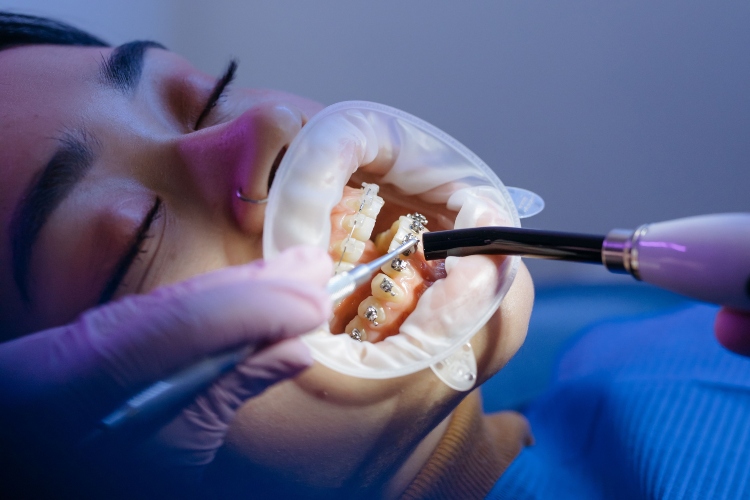
Traditional braces use brackets and archwires to guide teeth into better alignment. They can treat a broad range of orthodontic concerns, including crowding, spacing, and certain bite problems.
Because braces stay attached to the teeth, patients don’t need to remember to wear them. However, patients still need to brush carefully, make dietary adjustments, and attend scheduled appointments throughout treatment.
Discreet Invisalign Clear Aligners
Invisalign uses custom-made, transparent trays to gradually move teeth into planned positions. These removable aligners offer a discreet alternative to traditional braces for eligible patients.
Benefits include easier brushing and flossing, the ability to remove aligners for meals, and a less noticeable appearance. Successful treatment requires consistent wear and regular progress checks. Invisalign is not suitable for every alignment or bite concern, so an evaluation is necessary.
Six Month Smiles®
Six Month Smiles is designed primarily to address selected cosmetic alignment concerns, such as minor crowding or spacing. Despite its name, treatment is not guaranteed to take six months. It may not be appropriate for complex bite problems, and a consultation is needed to determine whether it suits your goals.
What Are the Benefits of Orthodontic Treatment?
Orthodontics can improve more than the appearance of your smile. Depending on your needs, treatment may offer several benefits:
- Straighter teeth: Improve the appearance of crowded, overlapping, or spaced teeth.
- Better bite alignment: Address issues with how your upper and lower teeth meet.
- Easier oral hygiene: Properly aligned teeth may be easier to brush and floss.
- More balanced tooth wear: Correcting certain bite problems may help distribute biting forces more evenly.
- Greater confidence: Many patients feel more comfortable with their smile after treatment.
Results vary, and orthodontic treatment does not eliminate the need for routine dental care. Good oral hygiene and retainer use remain important after treatment.
Who Is a Good Candidate for Orthodontics?
Children, teens, and adults may benefit from orthodontic treatment. You may want an evaluation if you have crooked teeth, gaps, crowding, protruding teeth, or an overbite, underbite, or crossbite. Difficulty cleaning crowded teeth may also be a reason to discuss alignment with your dentist.
Your provider will assess your teeth, gums, bite, and treatment goals before recommending an approach. Some patients benefit from early intervention, while others can wait until more permanent teeth have erupted. Adults can also pursue orthodontic treatment when their oral health supports it.
Invisalign vs. Traditional Braces: Which Is Better?
Both Invisalign and traditional braces can straighten teeth, but they differ in appearance and daily care.
| Feature | Invisalign | Traditional Braces |
|---|---|---|
| Appearance | Clear and discreet | Visible brackets and wires |
| Removable | Yes | No |
| Oral hygiene | Remove to brush and floss | Requires extra cleaning |
| Patient responsibility | Consistent aligner wear | Following care instructions |
| Treatment suitability | Selected cases | Broad range of cases |
Neither option is best for everyone. The right choice depends on your bite, the movements required, and your ability to follow treatment instructions. A consultation can help you compare your options.
What Should You Expect During Orthodontic Treatment?
Treatment begins with a consultation to discuss your concerns and smile goals. Your provider examines your teeth and bite and determines whether you need additional records or imaging. A personalized treatment plan outlines the recommended approach and estimated timeline.
Once treatment begins, periodic appointments help monitor progress and make adjustments as needed. After active treatment, retainers help maintain your new tooth positions. Treatment length varies depending on your case’s complexity and how your teeth respond.
Why Choose Blessed Smile Dentistry of Yorba Linda?
At Blessed Smile Dentistry, we help patients understand their treatment options and feel comfortable throughout their care. We consider your dental needs and smile goals when discussing potential solutions.
Our Yorba Linda office provides a convenient local option for patients exploring orthodontic services for themselves or their children. Our team can explain the next steps and help you decide which options may be right for you.
Orthodontics FAQs
What Do Orthodontics Involve?
Orthodontics is a branch of dentistry focused on correcting the alignment of teeth and jaws to improve function and aesthetics. Our skilled team treats various misalignment issues, from mild to more complex bite problems. Whether you get Invisalign clear braces or traditional braces or qualify for Six Month Smiles®, we’ll be there to monitor your progress every step of the way. Our goal with our orthodontic treatments is to streamline your care as much as possible, helping you fit the teeth straightening process into your lifestyle.
Do I Need Orthodontic Treatment?
If you’re experiencing issues such as crooked teeth, jaw pain, or difficulty chewing, orthodontic treatment may be your solution. Orthodontics can improve the appearance of your smile while also alleviating discomfort and improving the overall condition of your oral health. Common issues that can be corrected with orthodontic treatment include:
- Malocclusion (bite misalignment)
- Protruding teeth
- Bruxism (tooth grinding)
- Painful bite
- Spaces between teeth
What Is Six Month Smiles and Am I a Good Candidate?
Six Month Smiles is an innovative orthodontic treatment designed to correct minor teeth misalignments quickly and effectively. This accelerated treatment option focuses on improving the appearance of your smile in a shorter time frame compared to traditional orthodontic methods. During your initial orthodontic consultation at our practice, our experienced team will evaluate your teeth and discuss whether Six Month Smiles suits your needs. Whether you’re dealing with crowding, spacing, or other minor alignment issues, Six Month Smiles may be the perfect solution for you.
Will I Need A Retainer After Treatment?
Most patients need retainers to help prevent teeth from shifting after orthodontic treatment. Follow your provider’s instructions about retainer wear.
Can Adults Get Braces or Invisalign
Yes. Adults may be candidates for braces or Invisalign if their teeth and gums are healthy enough to support treatment. The best option depends on individual alignment needs.
Schedule an Orthodontic Consultation in Yorba Linda
Ready to explore braces, Invisalign, or orthodontic treatment for your child? Contact Blessed Smile Dentistry of Yorba Linda to discuss your smile goals and available options.
Related Procedures
Orthodontic Treatment (Braces)
Watch our 9 Things to Know Before Starting BRACES
The benefits of orthodontic treatment often go beyond the obvious physical changes of an improved bite and straighter teeth; it’s also a great way to improve a person’s overall self-image. While having beautiful straight teeth is important, even more important is the need to alleviate any potential health problems associated with the teeth or jaw. Crooked teeth or jaw problems may contribute to improper cleaning of teeth, leading to tooth decay and, possibly, gum disease or total tooth loss. Orthodontic problems that go untreated can lead to chewing and digestion difficulties, speech impairments, and abnormal wear of tooth surfaces. Over time, excessive strain on gum tissue and the bone that supports the teeth can affect the jaw joints leading to problems such as headaches or face and neck pain.
The American Association of Orthodontics recommends that children get an orthodontic evaluation no later than age 7. Though orthodontic treatment can be done at any age, timely treatment ensures maximum dental health.
With all of the recent advancements in orthodontics, wearing braces has never been easier. State-of-the-art appliances and treatments are now available, from traditional metal braces, to clear and tooth colored brackets, to NASA type wires that are heat activated and require fewer adjustments! Some patients may even be candidates for treatment with Invisalign, a revolutionary way to straighten teeth using clear, retainer type aligners that require no braces or wires!
If treatment is necessary, we will thoroughly discuss which treatment option is best suited for you!
Reasons for orthodontic treatment (braces) adults & children:
-
Breathing or swallowing problems – Mouth breathing can lead to snoring and sleep apnea.
-
Crossbite – One or more upper teeth bite inside the lower teeth (towards the tongue).
-
Crowding – Involving extra teeth or malpositioned teeth.
-
Deep Overbite – The lower front teeth bite into the upper tissue of the upper teeth.
-
Disfiguring of the face & mouth – Affects the development of the jaw and position of the teeth.
-
Jaw & jaw joint pain
-
Missing or extra teeth – Due to tooth decay, injuries, or inherited problems.
-
Overjet (protruding upper teeth) – Upper teeth that protrude beyond normal and are usually associated with a short lower jaw.
-
Self-image – An attractive smile can boost a person’s self-image and confidence.
-
Spacing between teeth – Teeth are missing or may be too small or too large.
-
Speech, chewing or biting problems
-
Underbite (lower jaw protrusion) – Lower jaw is longer than the upper jaw.
Specific to children:
-
Finger or thumb sucking – These habits can cause protrusion of the upper incisor teeth, and mouth breathing.
-
Teeth erupting out of position – Can be guided to proper alignment.
What does orthodontic treatment involve?
Orthodontic treatment involves three phases:
1. Planning Phase – Your first couple of visits may include the following:
-
A medical and dental history evaluation.
-
Castings or “molds” of your teeth.
-
Computer generated photograph of the head and neck that will aid in planning.
-
Photographs of your face and mouth.
-
X-rays of the teeth and jaws.
After careful planning, your orthodontist will design and apply braces or fabricate custom-made appliances for you.
2. Active Phase – Active treatment involves visiting your orthodontist on a regular basis for adjustments and following specific treatment requirements to ensure successful treatment.
3. Retention Phase – When treatment is completed, the braces and/or appliances are removed and a new appliance is made. Usually these retainers are removable and will maintain the changes made to your teeth if worn continuously until the teeth and bone are stabilized in their new positions.
Treatment and retention times vary depending on each individual case. Your orthodontist will ensure you have a successful treatment for a beautiful smile that can last a lifetime.
Orthodontics can not only help straighten your teeth, giving you an appealing smile, but can greatly contribute to the health of your jaw, teeth and sometimes your overall health.
Invisalign®
One of the primary concerns people often have about dental braces is the aesthetic impact of the metalwork on their smile. Especially for adults, the prospect of wearing unattractive metal braces for long periods of time can be very discouraging. Invisalign® offers an almost invisible aligning system that straightens teeth fast and contains no metal.
Invisalign® treatment consists of a series of custom-made aligning trays. The dentist changes the trays every several weeks to fit the new tooth configuration. In addition to the reduced visual impact, Invisalign® aligning trays can be temporarily removed for important occasions – meaning that treatment duration is patient-controlled. A great number of people report complete satisfaction with both the Invisalign® treatment and the stunning results.
What kind of bite problems can Invisalign® correct?
Invisalign® corrects the same dental problems as traditional metal braces; the only difference is that Invisalign® trays are almost invisible to the naked eye, and can be removed at will.
Here are some problems that are commonly corrected with Invisalign®:
-
Overcrowding – This occurs when there is too little space for the teeth to align normally in the mouth. Overcrowding can cause tooth decay and increase the likelihood of gum disease.
-
Large gaps between teeth – This can sometimes occur because teeth are missing or because the jaw continues to grow abnormally.
-
Crossbite – This common dental problem occurs when one or multiple upper teeth bite inside the lower teeth. As a consequence, uneven wear can lead to bone erosion and gum disease.
-
Overbite – This problem occurs when the upper teeth project further than, or completely cover, the lower teeth. Eventually, jaw pain and TMJ may occur.
-
Underbite – This is the inverse of the overbite; the lower teeth project further than, or completely cover, the upper teeth. Eventually, jaw pain and TMJ can occur.
What advantages does Invisalign® offer over traditional braces and veneers?
Traditional dental braces, Invisalign® aligning trays, and dental veneers are three different ways to perfect the alignment of the teeth. There are many different considerations to make when deciding which treatment will be best, and each of these options works better in certain situations.
Invisalign® differs from traditional braces in that the aligning trays are fully removable. This means that more discipline and commitment is required from the patient. This is not usually a problem since the trays are comfortable and nearly invisible. Almost identical results can be obtained by using either treatment.
Invisalign® is preferable to veneers in many cases because unlike veneers, Invisalign® actually straightens the teeth. Veneers are thin covers that the dentist permanently affixes to the teeth. Teeth must be etched beforehand, meaning that to remove dental veneers, an alternative covering must be constructed. In addition to being somewhat expensive, veneers can break and often last for less than 20 years.
What does Invisalign® treatment involve?
First, the dentist needs to devise an initial treatment plan before creating the special aligning trays. Three-dimensional digital images are taken of the entire jaw. These images allow the dentist to move specific teeth on the screen, view the jaw from different angles, and also foresee what the face might look like in years to come. In essence, this technology can show how Invisalign® trays will change the facial aesthetics.
Once planning is complete, a unique set of aligners is made. The total amount of aligners required varies with each individual case, but 20-29 sets per arch is typical.
What are some considerations when wearing Invisalign® trays?
Life with Invisalign® aligning trays may take several weeks to get used to. The trays should be worn constantly, except when eating and drinking. It is important to remove the trays when consuming food or drink because food can become trapped between the tray and the teeth, causing tooth decay.
Usually, new trays are necessary every two weeks, and progress between appointments can be seen with the naked eye. There is no doubt that Invisalign® aligning trays have revolutionized orthodontics. Invisalign® is renowned for being both comfortable and effective.
If you have questions about Invisalign®, please contact our office.
6 Month Smiles®
Now, more than ever, patients are concerned about issues beyond the health of their teeth; namely, they’re troubled about the aesthetic appearance of their smiles. While metal braces seem unpleasant and alternatives are expensive, 6 Month Smiles® is the innovative orthodontic solution that helps you achieve the smile you’ve always wanted, often in less time and with lower costs.
6 Month Smiles® is the ideal solution for adults who are insecure about the appearance of their smile. This orthodontic treatment utilizes shape-memory wires that are engineered to provide exceptional results without unsightly metal braces or having to destroy your natural teeth for the placement of veneers. With clear brackets and tooth-colored wires, the 6 Month Smiles® system is nearly invisible while it restores your confidence.
Benefits of the 6 Month Smiles® system
Some of the benefits of 6 Month Smiles® include:
- Most patients only undergo treatment for 6 months.
- Treatment is virtually invisible with clear brackets and tooth-colored wires, providing a discreet alternative to unsightly metal braces.
- Patented, shape-memory wires move teeth faster than traditional braces or aligner therapy solutions like Invisalign®.
- Patented tray kits allow for quick and painless application.
- Your resulting straighter smiles allows for better oral hygiene.
What does treatment involve?
At your initial consultation, our 6 Month Smiles® certified doctor can determine whether you are a suitable candidate. After you have decided to pursue treatment, molds of your teeth will be taken and sent to the 6 Month Smiles® laboratory. The 6 Month Smiles® lab technicians will manufacture bonding trays, custom-fit to your teeth and sends them back to our office within two weeks. We will then schedule a follow-up appointment, during which the dentist will apply your braces.
You will be required to schedule monthly appointments, so the dentist can adjust your braces to advance the straightening process. Within 4 to 9 months, treatment is finished, with most cases requiring only 6 months of treatment. Upon removing your braces, we will discuss retention options with you, so you can choose a suitable solution that helps maintain your newly straight smile.
If you think the 6 Month Smiles® system could work for you, contact us at your convenience.